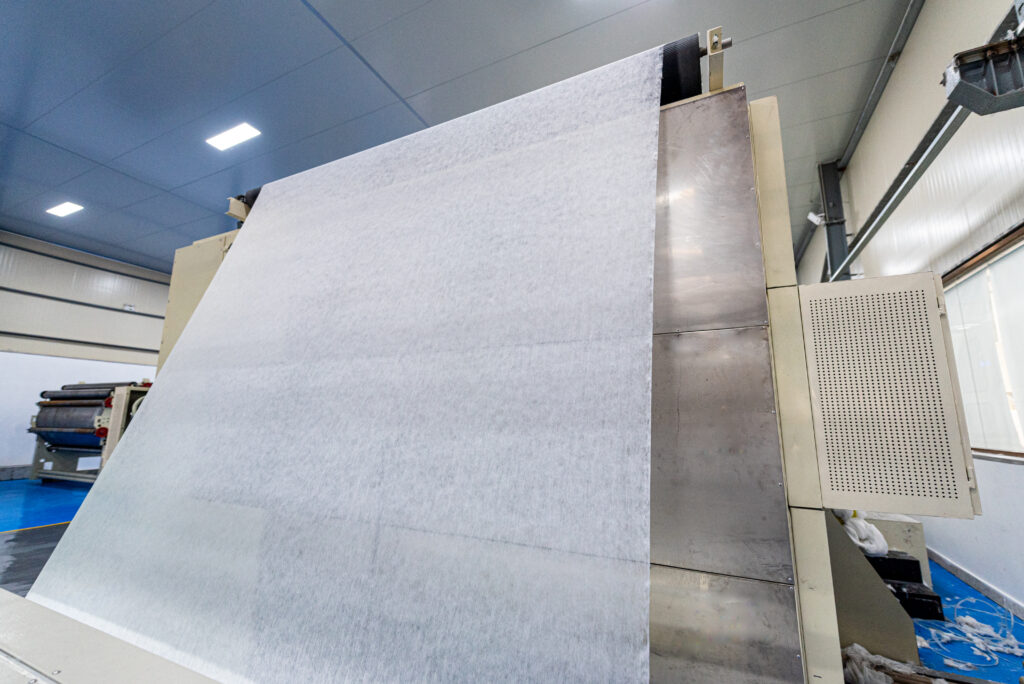
Air Through Bonding is a critical web consolidation technique in the production of non-woven fabrics. Its core principle involves using hot air as an energy carrier. The hot air penetrates the freshly formed fiber web within a drying unit, causing the low-melt fibers (such as ES sheath-core composite fibers) or bicomponent fibers mixed within the web to melt. The molten polymer flows and forms bonds at the intersection points of the fibers, which solidify upon cooling, thereby reinforcing the web and imparting the desired physical properties to the non-woven fabric.
This process differs significantly from calendering bonding, which relies on mechanical pressure and heat. The defining characteristic of Air Through Bonding is its use of non-contact heating. As the hot air passes through the web, the fiber structure remains uncompressed and undamaged by mechanical force. This allows the fabric to retain the fibers’ original three-dimensional crimp and bulky structure to the maximum extent. Consequently, the final product boasts exceptional soft hand feel, high bulkiness, excellent breathability, and superior elastic recovery.

In terms of applications, non-wovens produced via the Air Through Bonding process are extremely versatile:
- Hygiene Sector:Â Used as the top sheet or acquisition distribution layer for baby diapers, feminine hygiene products, and adult incontinence pads, providing a dry and soft feel against the skin.
- Home Textiles:Â Employed in the production of insulation linings for cold-weather clothing, quilts, mattresses, cushion pads, and other materials requiring warmth retention and filling.
- Technical Textiles:Â Plays a significant role in manufacturing filtration materials, acoustic insulation materials, and damping materials.
Jinyi Machinery possesses a profound understanding of the ultimate pursuit of softness and bulkiness in end-products through the Air Through Bonding process. We provide advanced hot air ovens and complete non-woven production lines. By precisely controlling the temperature, penetration pressure, and dwell time of the hot air, we ensure uniform “point bonding” of the low-melt fibers. Our equipment is designed to accommodate a wide range of fabric weights, from lightweight materials of 16 g/m² to heavy grades up to 2500 g/m². We empower our clients to manufacture high-value-added air-through non-wovens with superior hand feel and stable performance, confidently meeting the challenges of an evolving market.